Repairing a leaking faucet
A leaking faucet is annoying and causes extra costs due to water wastage.
There are essentially two types of faucets: those with a washer or those with a thermostat (ceramic discs). If the washer is broken, it can no longer stop the water from the mains. This causes the faucet to leak. This is easy to fix yourself with the following steps.

Do you have a faucet with ceramic discs? Then replacing the entire faucet is your only solution. Browse our selection of faucets and make an affordable and good choice from one of our selection.
Know your faucet type
Faucets come in all shapes and sizes. They each have their own installation methods and potential causes of leaks. By learning about the four most common types of faucets, you'll know how to disassemble them and carry out any necessary repairs.
Pattern tap
You'll usually find these in bathroom sinks . You'll recognize them by the handles on either side of the spout that move up and down to turn the water on and off. Inside the sink, there's a cartridge that moves up and down to regulate the water flow.
Disc tap
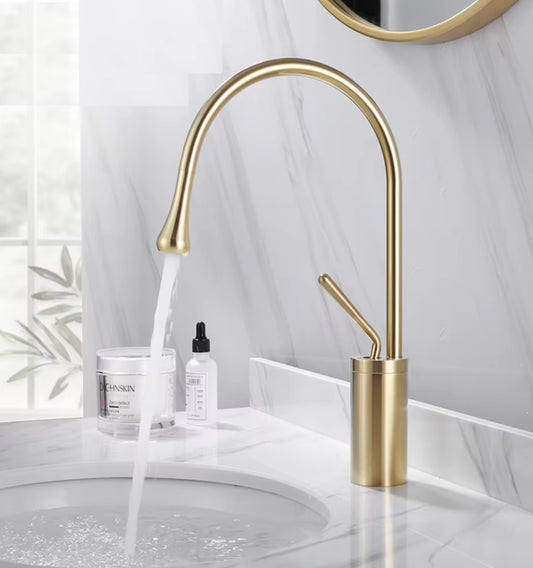
These newer and more expensive options operate with a single lever that rests on a cylindrical faucet body.
Ball tap
These faucets, usually found in kitchens , use a ball joint to switch between hot and cold water. A single handle sits on a round cap mounted on top of the spout. You push up and down to adjust the pressure, and left and right to adjust the temperature.
Compression washer tap
The oldest type of faucet, compression wash faucets, are still in use. Their two handles move back and forth. You feel the faucet handle tighten as you close it. These use rubber rings that seal the water flow.
Step 1: Turn off the central water supply
Inform other residents or users before completely shutting off the water. Also, make sure no washing machine or dishwasher is running. Turn off the main water valve; this is often located at the entrance to the house near the front door. Now open all higher-level taps and wait until the water stops flowing from the pipes.

Step 2: Unscrew the faucet knob from the faucet
You can turn the control knob off the tap, or on some taps you have to unscrew the screw located under the colored cap.
Step 3 Check the tap washer that is in the tap housing
To do this, unscrew the decorative sleeve. Note: Place a cloth in the jaws of the pliers to avoid unnecessary damage to the decorative sleeve. Then unscrew the internals of the faucet. Check the washer in the faucet body for signs of wear. Check for cracks and whether it's thick enough.
Step 4 Remove the tap washer from the tap
Now unscrew the nut or screw that secures the tap washer. Then remove the washer.
Important Tip!
There are different types of faucets , each requiring a washer with a different thickness and diameter. Therefore, purchase an assortment of washers in advance. This way, you're always sure to have the right size.
Step 5 Remove any limescale
Remove any limescale from the faucet parts with a good descaling agent (for example, Dasty purple, available at Wibra). Place the parts (internal parts, not the faucet itself) in a bath of descaling agent and let it work for at least 12 hours. Then rinse thoroughly with lukewarm water and dry. Now install a new washer of the correct size in the faucet.
You can also use natural vinegar instead of a descaling agent. Soak the faucet parts thoroughly in a bowl of vinegar for a few hours.

Step 6 Replace the faucet gasket
Install a new gasket in the faucet body. A gasket is also called a rubber seal or sealing ring. Now fully open the faucet's internals. Screw the internals back into the faucet body. Now tighten the decorative sleeve. Push or screw the knob back onto the faucet.
It's not always necessary to replace the sealing ring, but if you've already taken the tap apart, it's recommended to do so now.

For some faucets, it's helpful to screw a foam jet nozzle onto the spout. This nozzle saves a lot of water and provides the same level of comfort.
Step 7: Turn the main water tap back on
Then close all open taps and turn the main water valve back on. Check that the water is flowing properly and that your tap is no longer leaking.